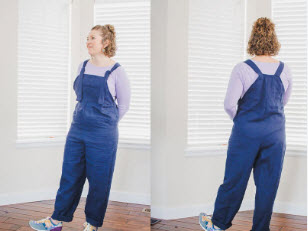
Creating a sewing pattern for a jumpsuit can be a rewarding project, but it can also be a bit complex due to the various components involved. Jumpsuits can be one-piece or two-piece (top and pants), and they come in various styles, such as casual, formal, or utility. Here's a simplified guide to creating a basic jumpsuit sewing pattern:
Materials and Tools:
- Fabric (cotton, linen, rayon, denim, or any fabric of your choice)
- Sewing machine
- Scissors
- Measuring tape
- Straight pins or clips
- Safety pins
- Iron and ironing board
- Pattern paper or large sheets of paper
Instructions:
- Take Measurements:
- Measure your bust, waist, hips, inseam (for pants), and the desired length of the jumpsuit.
- Add ease to these measurements for comfort. Typically, add 2-4 inches (5-10 cm) to your bust and hip measurements.
- Create the Pattern for the Jumpsuit:
- Fold your pattern paper or large sheets of paper in half.
- On the folded edge, mark a point for the top corner (shoulder) of your jumpsuit. Measure down from this point to mark the desired length for your jumpsuit.
- From the shoulder point, measure out to the side to mark half of your bust measurement + ease. Draw a straight line from this point to the waistline of your jumpsuit.
- For the waist, measure down from the bust line and mark your waist half-measurement + ease. Connect this point to the hips by drawing a straight line.
- From the waist point, measure down to mark your hip half-measurement + ease. Draw a straight line to the bottom edge (hem) of your jumpsuit pattern.
- Cut along these lines, and you've created half of your jumpsuit pattern.
- Add seam allowances (typically 1/2 inch or 1.27 cm) to all edges except the center front (for a zipper or button placket), which should have a larger seam allowance (1 inch or 2.54 cm).
- Cut Out Fabric:
- Fold your fabric in half, right sides facing each other.
- Pin the pattern piece to the fabric and cut around it, adding the necessary seam allowances.
- Cut a second piece for the back of the jumpsuit.
- Sewing Techniques:
- Use a sewing machine with a straight stitch for most seams. For stretchy fabrics, consider using a stretch stitch or a serger.
- Assemble the Jumpsuit:
- With right sides facing, sew the shoulder seams, side seams, and inseam for the pants (if applicable).
- Finish the seam allowances with a zigzag stitch or serger to prevent fraying.
- Attach sleeves (if your jumpsuit has them) and finish the armhole edges.
- Create the Waistband Casing:
- Fold down the top edge of the jumpsuit twice to create a casing for elastic or a drawstring. Pin in place.
- Sew along the lower edge of the casing, leaving a small opening to insert the elastic or drawstring.
- Insert Elastic or Drawstring:
- Using a safety pin, thread an elastic band or drawstring through the waistband casing. Ensure it's snug but not too tight.
- Sew the ends of the elastic or drawstring together securely.
- Close the opening in the waistband casing.
- Hem the Jumpsuit:
- Fold the bottom hem edge of the pants or shorts twice to create neat hems. Pin in place.
- Sew the hems in place.
- Final Pressing:
- Press the jumpsuit with an iron to remove any wrinkles and create crisp seams.
Now, your jumpsuit is ready to wear. Customize it by choosing different fabrics, adding pockets, or adjusting the length and style to suit your preferences. Be sure to follow any specific pattern instructions for unique construction details in your chosen jumpsuit design.